Micro-Frets Orbiter Semi-Hollow Body Electric Guitar (1968)

LOADING IMAGES
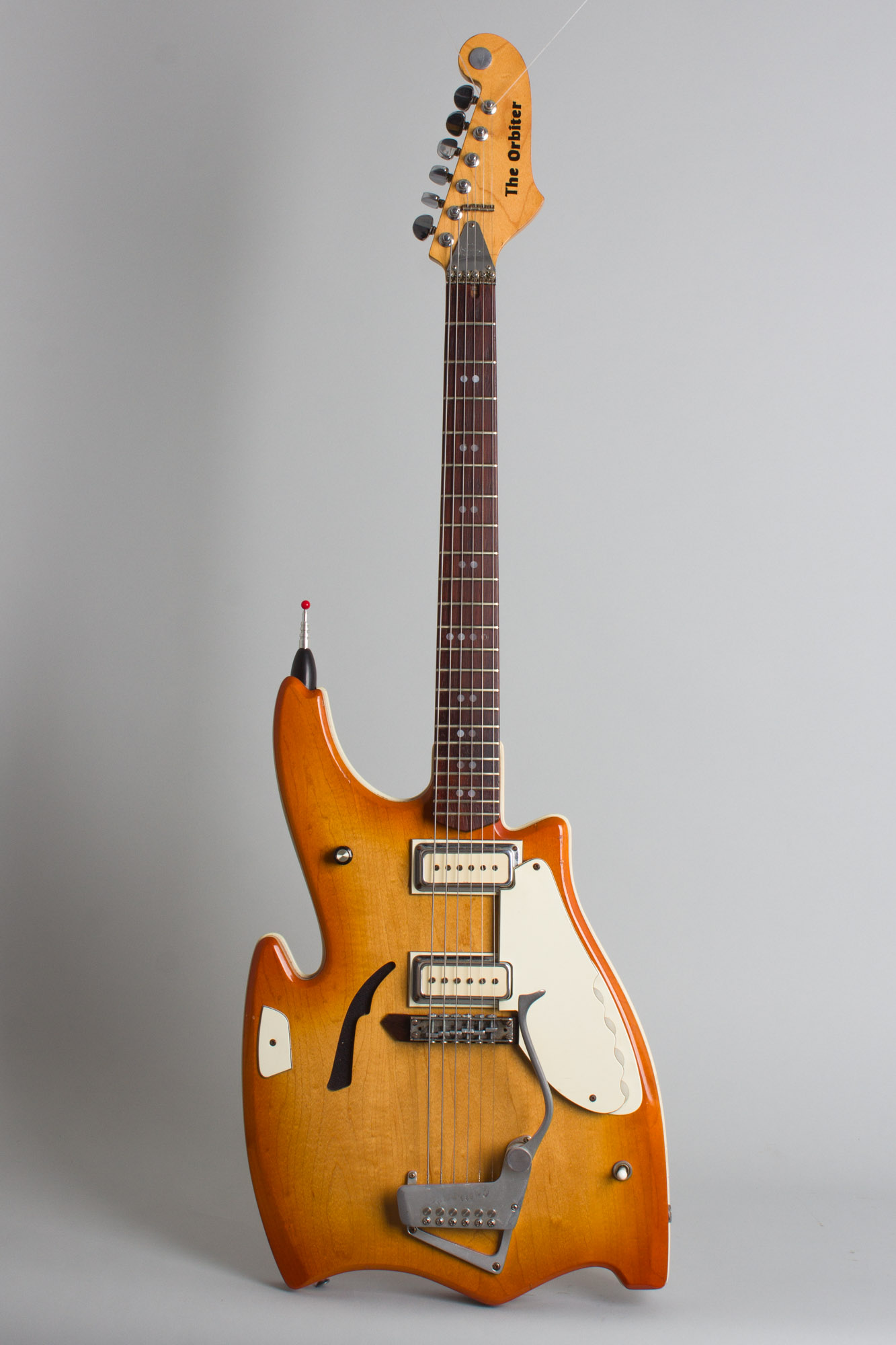

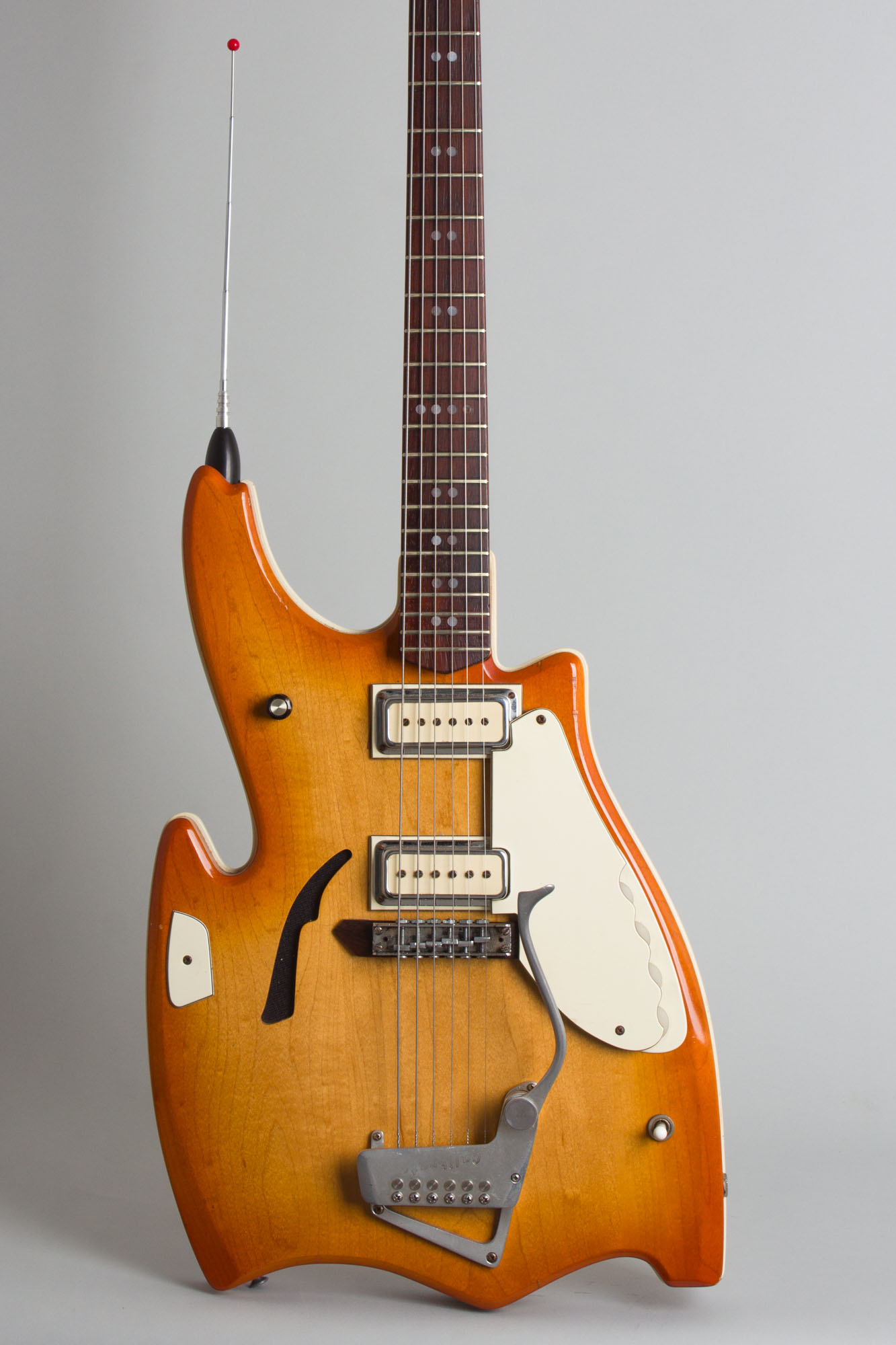
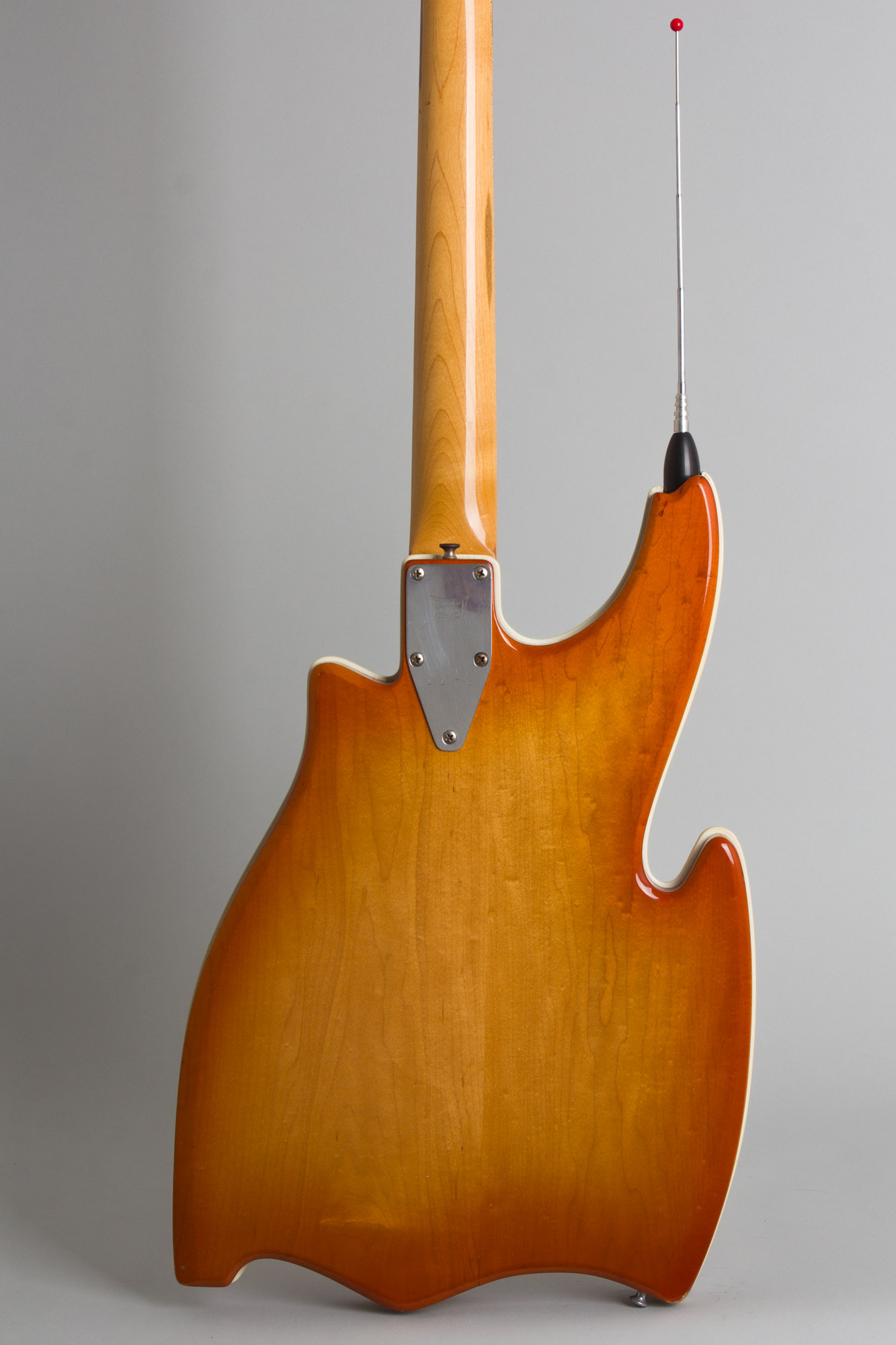
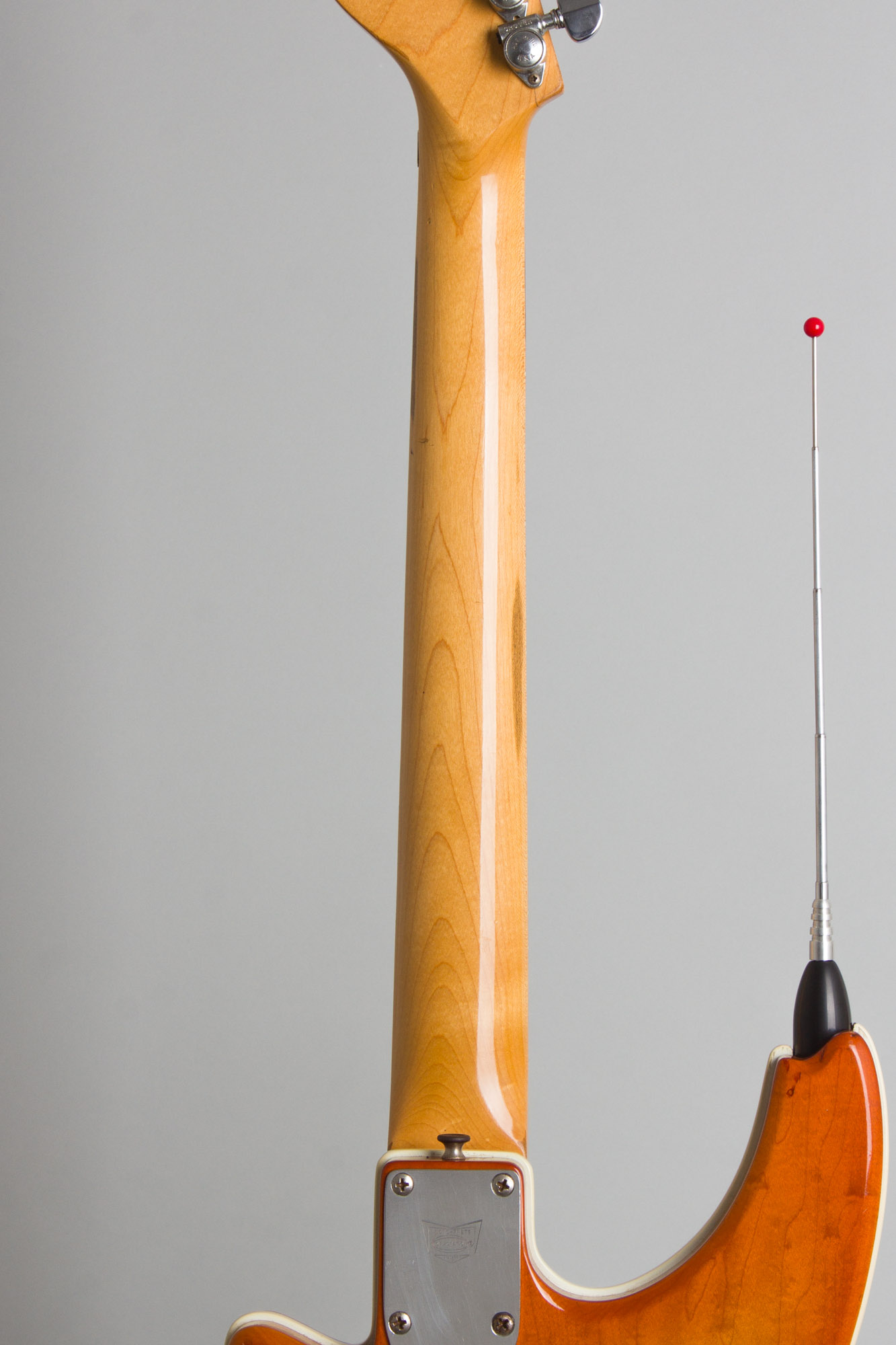
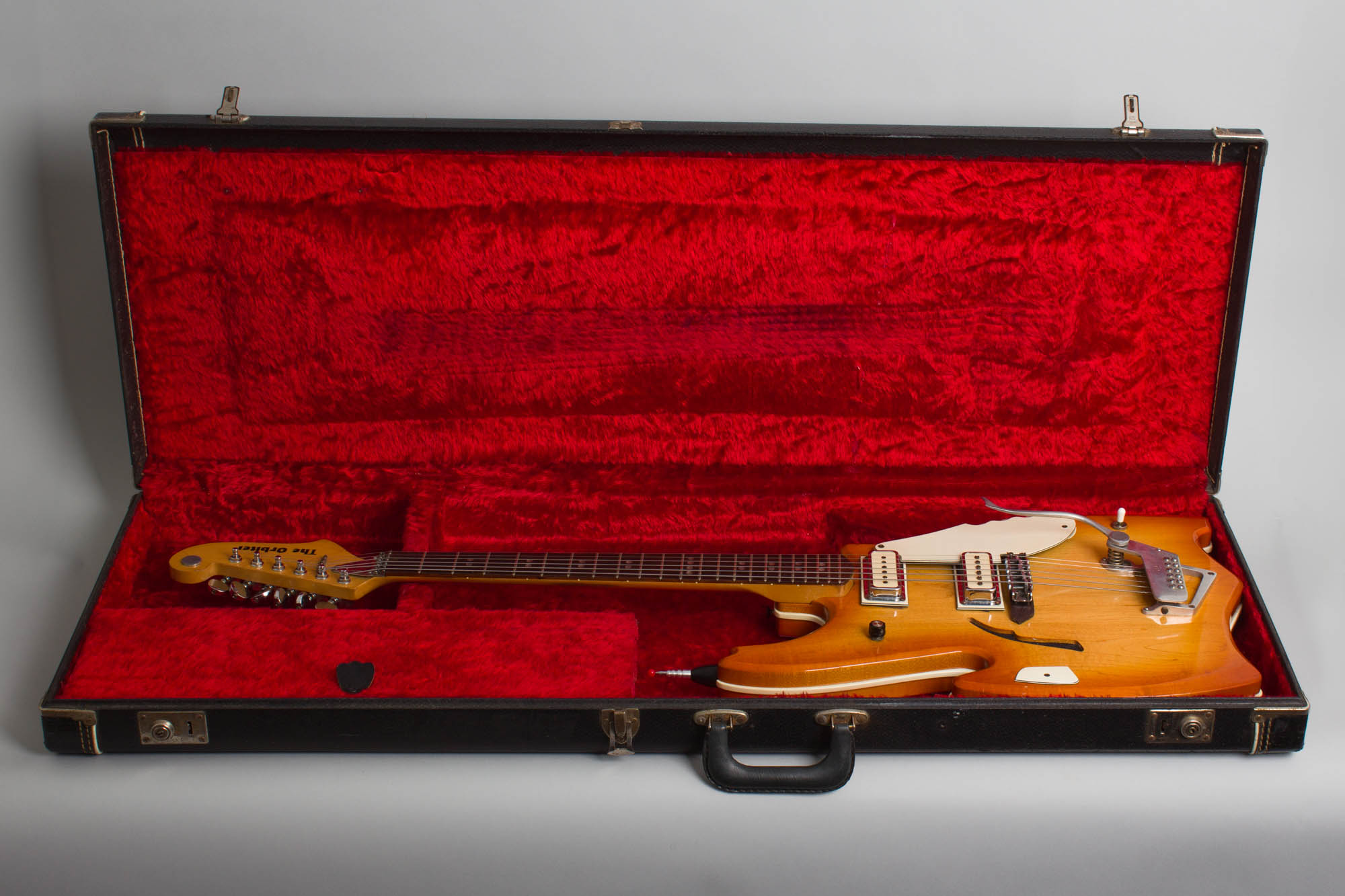

Micro-Frets Orbiter Model Semi-Hollow Body Electric Guitar (1968), made in Fredrick, Maryland, serial # 1178, amber sunburst finish, maple body, maple neck with rosewood fingerboard, original black tolex hard shell case.
Some of the most unique and original American guitars of the late 1960s and early 1970s came out of Frederick, Maryland, where the small Micro-Frets company built their beautifully engineered if offbeat instruments. Of all of their varied offerings this amazing looking Orbiter is THE more sought-after model, the ultimate in a Micro-Frets Holy grail. By the standards of 1968 it really does look like it just came down from outer space, the perfect guitar for bubble-helmeted cartoon aliens (Ahoy Colonel Bleep!) to serenade the Earthlings with.
The Micro-Frets was the brainchild of one Ralph Jones, a self-taught engineer and inveterate tinkerer. Jones perfected what he called the "Calibrato" vibrato unit in 1965, designed to enable individual tension adjustments for each string, theoretically allowing entire chords to be raised and lowered remaining in tune. Failing to interest established manufacturers, he went the next step and with financial help from his former employer started his own guitar firm.
Micro-Frets was launched in 1967, by the following year producing an amazingly extensive line of utterly unique semi-solid electric guitars. The Orbiter is one of, if not THE rarest Micro-frets model, built on a wildly asymmetrical double-cutaway, semi-hollow body. This is made up of a two-piece maple sandwich routed from the inside, clipped onto a "Tempered Masonite" center frame. Collectors have identified three major stages in their evolution through the company's demise in 1975, dubbed type 1, 2 and 3; this Orbiter a "Type 1". Micro-Frets serial numbers appear to start at either 1000 or 1100; in either case at #1178 this is a very early model and Orbiters have proven so scarce it is likely only a handful were actually made.
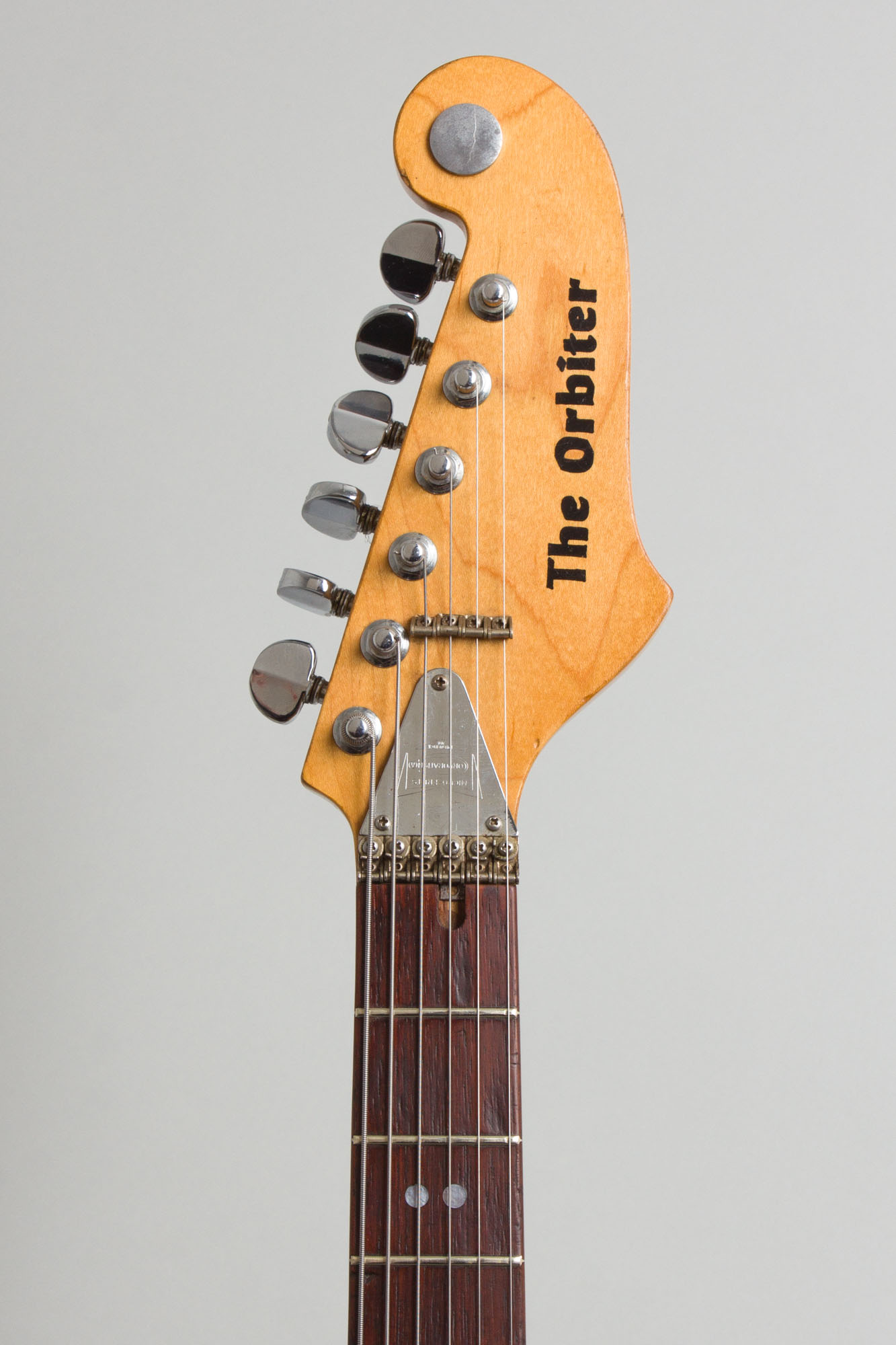
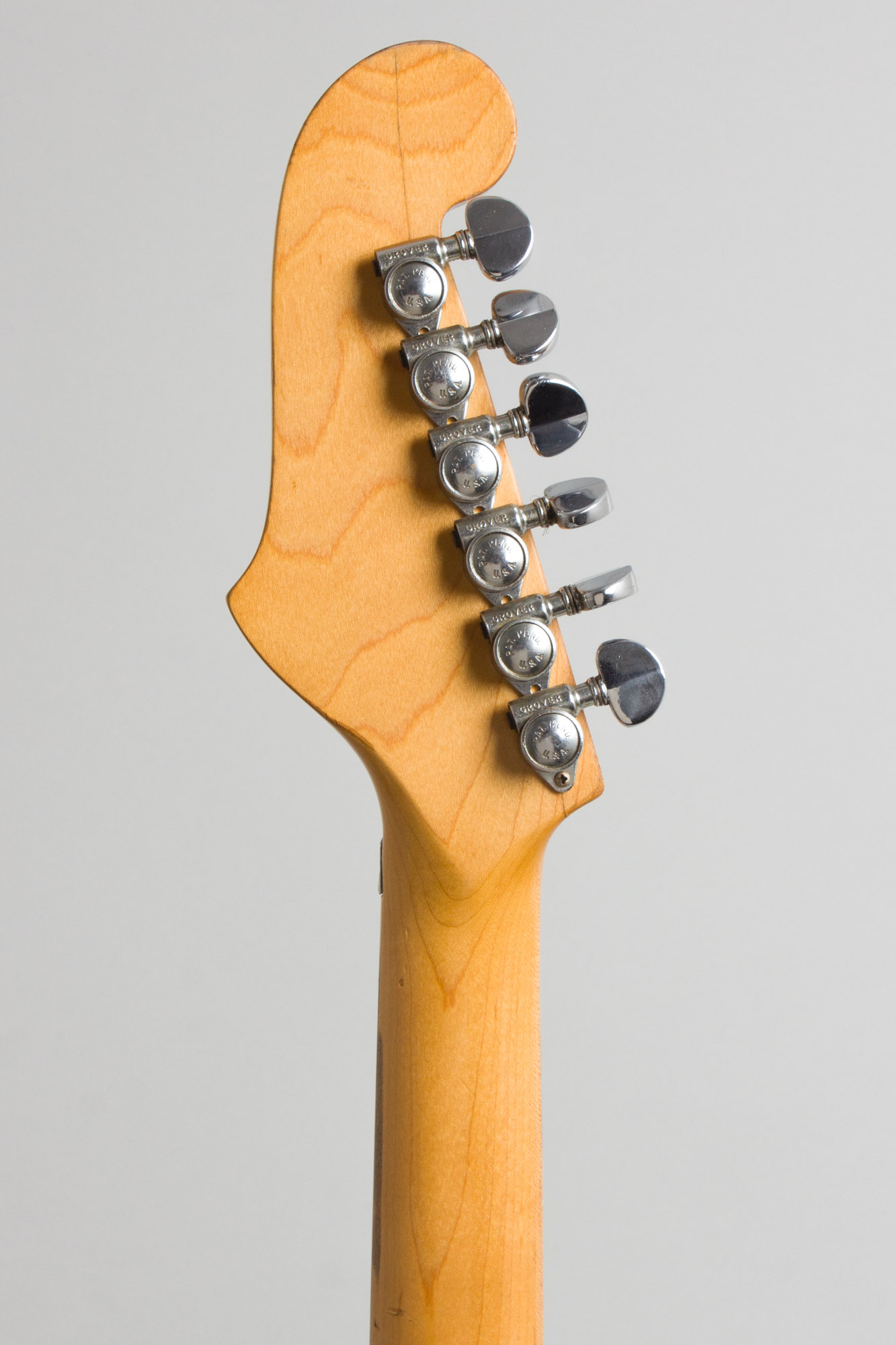
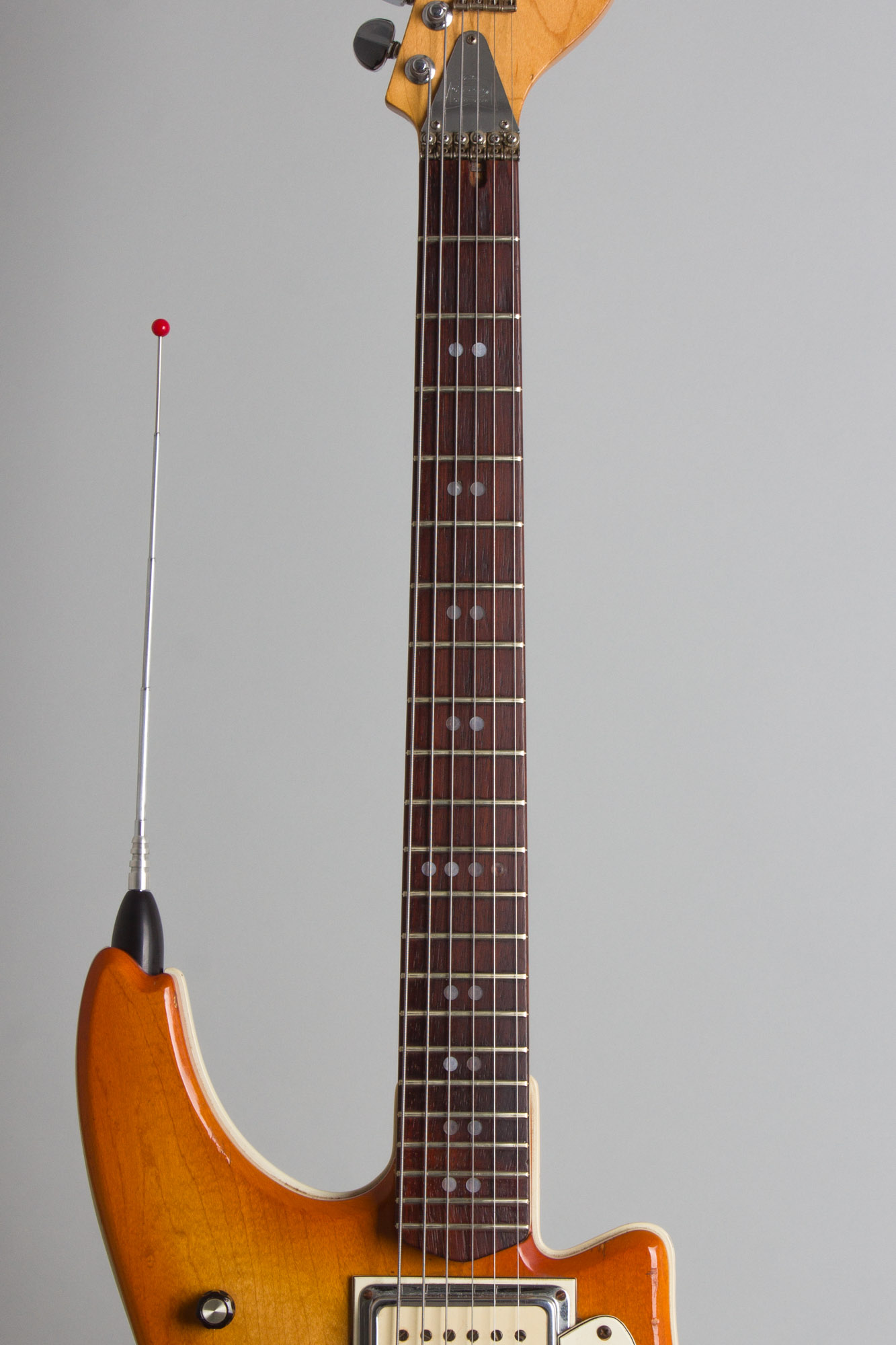
Jones called this construction the "Tonesponder" body; Micro-Frets rivals the UK's Burns firm in coming up with snazzy names. Another universal feature is the patented Micro-Nut, which allows harmonic compensation at the headstock and individual string height adjustments. This sits on a maple neck with an unbound rosewood fingerboard inlaid in an eccentric multi-dot pattern. The single-sided headstock is a swooping Fender/Bigsby inspired shape, with "Patent Pending" Grover Rotomatic tuners fitted so closely the mounting tabs had to be clipped slightly to fit. The headstock has a decorative metal disc on the ball end, with no brand logo but a bold "THE ORBITER" decal.
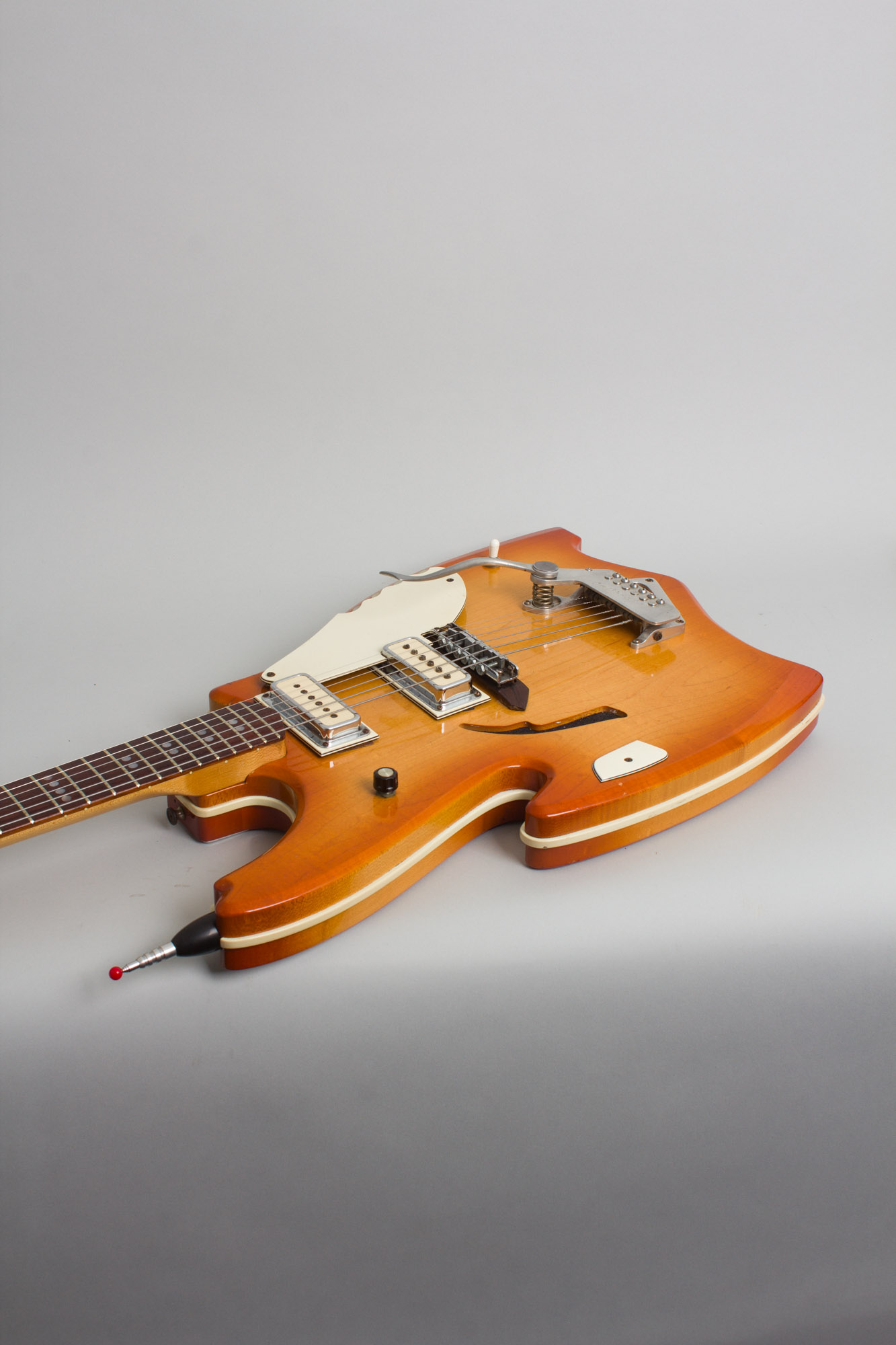
At the other end of the strings is a first-pattern "Calibrato" vibrato unit, heart of the Micro-Frets legend. This is the early version, more Bigsby-like than the second integral bridge/tailpiece model that appeared in 1969. The Calibrato was advertised as having "Precise Pitch modulation" and Jones wrote elaborate treatises on its function; basically there is an adjustable screw for each string that theoretically individually fine-tunes the exact pitch change. This is coupled with the "Microsonic" bridge adjustable for overall height and each string's intonation. This earlier version appears very Rickenbacker-like and mounts to a floating wooden base.
The maple body is finished in a light brown sunburst with a white center gasket, pickguard and trim. The single stylized F-hole is filled with black fabric. Individual tone and volume controls for the two pickups are carried laterally on the top-mounted pickguard, which is bi-level in the Rickenbacker mode with a triple laminate upper section. A 3-way selector switch is mounted to the body behind this. The pickups are DeArmond single-coil units with small adjustable poles; the next year Jones would perfect his own pickups with help from Bill Lawrence.
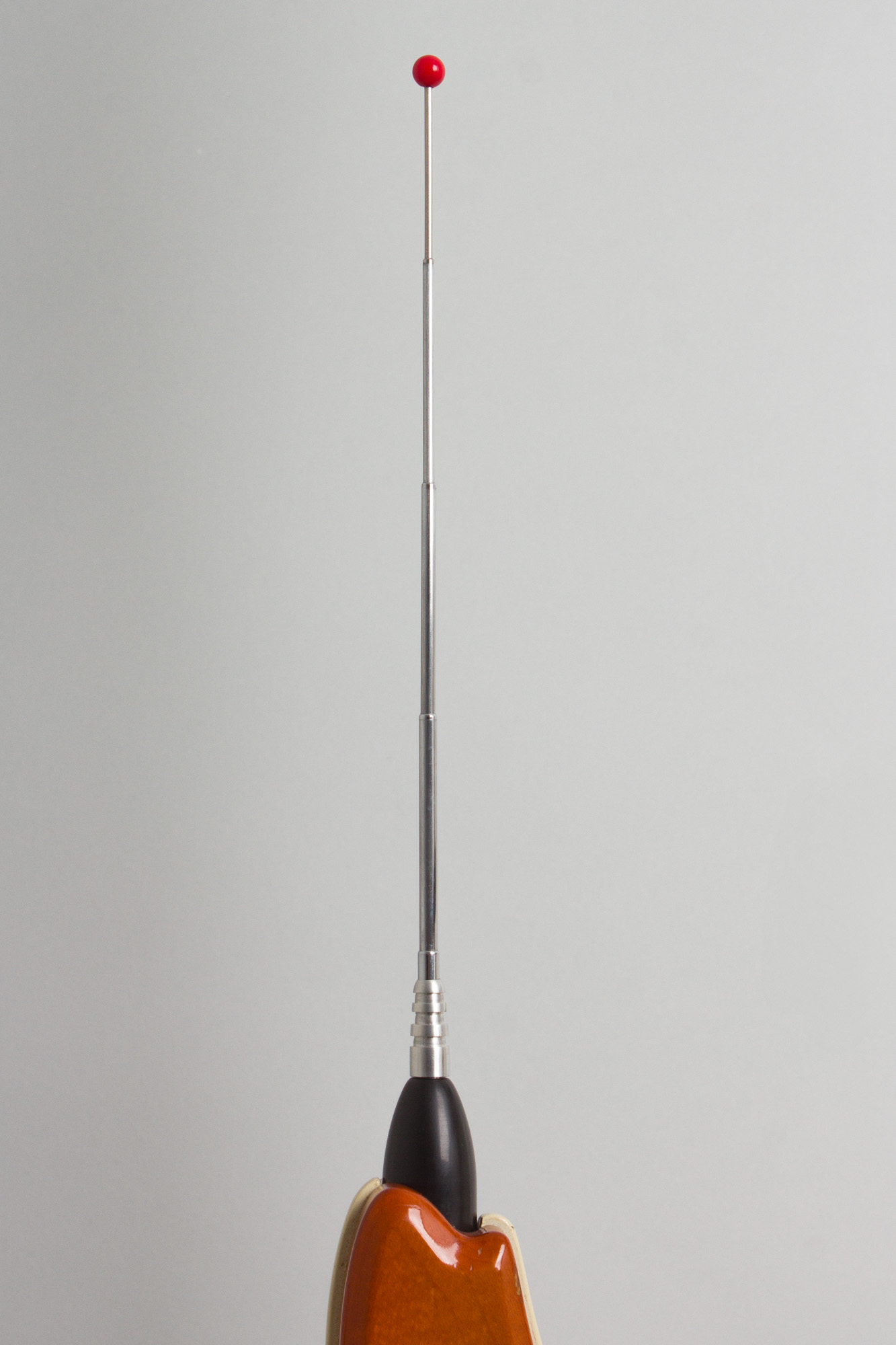
The most over the top feature of the Orbiter (more or less, take your pick!) is a built in FM transmitter in the upper body which supposedly eliminated the need for a cord, IF you had the receiving unit. This is controlled by the small 2-way frequency selector knob on the upper bout; the antenna is mounted in the upper horn and can be extended almost to the first fret area! A small hatch on the upper face accesses the battery compartment. We don't have anything to receive the signal, so can't say if this guitar is still broadcasting but in any case a patch cord into the jack works just fine!
This very rare and head-turning Orbiter is as cool as Micro-Frets ever got but besides its looks is also a well-made and fine playing guitar with a slim comfortable neck and bright, responsive pickups. The sound is crisp and hi-fi with surprising depth when needed. "Micro-Frets: the Personal guitar" was the slogan, highlighting the extensive adjustability of nearly every component. A number of prominent country artists endorsed Micro-Frets in the late 1960's including Carl Perkins, Buck Trent, Tommy Cash and the Statler Brothers, although we have never seen ANYONE pictured with an Orbiter. A single picture in Wheeler's AMERICAN GUITARS is the instrument's main legacy, this is the first one we have ever seen "in the wood". Micro-Frets had a fairly short history but the well engineered instruments they left behind remain totally unique, fine examples of American guitar ingenuity and fretted conversation pieces par excellence.
Overall length is 41 1/2 in. (105.4 cm.), 13 7/8 in. (35.2 cm.) wide at lower bout, and 1 7/8 in. (4.8 cm.) in depth, measured at side of rim. Scale length is 24 in. (610 mm.). Width of nut is 1 5/8 in. (41 mm.).
This very rare and super sharp looking guitar remains original as far as we can tell; frankly there's not much comparison available out there! It shows some fairly light general wear and minor repair; the body finish has some small dings, scratches and dents mostly into but not through the finish concentrated along the edges. The back of the neck is comparatively clean with a couple of small areas worn to the wood and a few small dinks.
There are small sealed splits to the back of the headstock below the low E tuner and above the high E, this one running up to the tip. Both of these have been solidly sealed up and neither went all the way through to the headstock face; these are not uncommon on Micro-frets headstocks likely the result of the wood shrinking around Grover tuners. The frets and fingerboard have some wear in the lower positions but playability remains good. This is a super example of the rarest first-generation Micro-Frets; these were only built in extremely small numbers, making for a far rarer find than most of the company's models. We have never seen another! It resides in the original early-pattern Micro-Frets branded HSC. Overall Very Good + Condition.
Some of the most unique and original American guitars of the late 1960s and early 1970s came out of Frederick, Maryland, where the small Micro-Frets company built their beautifully engineered if offbeat instruments. Of all of their varied offerings this amazing looking Orbiter is THE more sought-after model, the ultimate in a Micro-Frets Holy grail. By the standards of 1968 it really does look like it just came down from outer space, the perfect guitar for bubble-helmeted cartoon aliens (Ahoy Colonel Bleep!) to serenade the Earthlings with.
The Micro-Frets was the brainchild of one Ralph Jones, a self-taught engineer and inveterate tinkerer. Jones perfected what he called the "Calibrato" vibrato unit in 1965, designed to enable individual tension adjustments for each string, theoretically allowing entire chords to be raised and lowered remaining in tune. Failing to interest established manufacturers, he went the next step and with financial help from his former employer started his own guitar firm.
Micro-Frets was launched in 1967, by the following year producing an amazingly extensive line of utterly unique semi-solid electric guitars. The Orbiter is one of, if not THE rarest Micro-frets model, built on a wildly asymmetrical double-cutaway, semi-hollow body. This is made up of a two-piece maple sandwich routed from the inside, clipped onto a "Tempered Masonite" center frame. Collectors have identified three major stages in their evolution through the company's demise in 1975, dubbed type 1, 2 and 3; this Orbiter a "Type 1". Micro-Frets serial numbers appear to start at either 1000 or 1100; in either case at #1178 this is a very early model and Orbiters have proven so scarce it is likely only a handful were actually made.
Jones called this construction the "Tonesponder" body; Micro-Frets rivals the UK's Burns firm in coming up with snazzy names. Another universal feature is the patented Micro-Nut, which allows harmonic compensation at the headstock and individual string height adjustments. This sits on a maple neck with an unbound rosewood fingerboard inlaid in an eccentric multi-dot pattern. The single-sided headstock is a swooping Fender/Bigsby inspired shape, with "Patent Pending" Grover Rotomatic tuners fitted so closely the mounting tabs had to be clipped slightly to fit. The headstock has a decorative metal disc on the ball end, with no brand logo but a bold "THE ORBITER" decal.
At the other end of the strings is a first-pattern "Calibrato" vibrato unit, heart of the Micro-Frets legend. This is the early version, more Bigsby-like than the second integral bridge/tailpiece model that appeared in 1969. The Calibrato was advertised as having "Precise Pitch modulation" and Jones wrote elaborate treatises on its function; basically there is an adjustable screw for each string that theoretically individually fine-tunes the exact pitch change. This is coupled with the "Microsonic" bridge adjustable for overall height and each string's intonation. This earlier version appears very Rickenbacker-like and mounts to a floating wooden base.
The maple body is finished in a light brown sunburst with a white center gasket, pickguard and trim. The single stylized F-hole is filled with black fabric. Individual tone and volume controls for the two pickups are carried laterally on the top-mounted pickguard, which is bi-level in the Rickenbacker mode with a triple laminate upper section. A 3-way selector switch is mounted to the body behind this. The pickups are DeArmond single-coil units with small adjustable poles; the next year Jones would perfect his own pickups with help from Bill Lawrence.
The most over the top feature of the Orbiter (more or less, take your pick!) is a built in FM transmitter in the upper body which supposedly eliminated the need for a cord, IF you had the receiving unit. This is controlled by the small 2-way frequency selector knob on the upper bout; the antenna is mounted in the upper horn and can be extended almost to the first fret area! A small hatch on the upper face accesses the battery compartment. We don't have anything to receive the signal, so can't say if this guitar is still broadcasting but in any case a patch cord into the jack works just fine!
This very rare and head-turning Orbiter is as cool as Micro-Frets ever got but besides its looks is also a well-made and fine playing guitar with a slim comfortable neck and bright, responsive pickups. The sound is crisp and hi-fi with surprising depth when needed. "Micro-Frets: the Personal guitar" was the slogan, highlighting the extensive adjustability of nearly every component. A number of prominent country artists endorsed Micro-Frets in the late 1960's including Carl Perkins, Buck Trent, Tommy Cash and the Statler Brothers, although we have never seen ANYONE pictured with an Orbiter. A single picture in Wheeler's AMERICAN GUITARS is the instrument's main legacy, this is the first one we have ever seen "in the wood". Micro-Frets had a fairly short history but the well engineered instruments they left behind remain totally unique, fine examples of American guitar ingenuity and fretted conversation pieces par excellence.
Overall length is 41 1/2 in. (105.4 cm.), 13 7/8 in. (35.2 cm.) wide at lower bout, and 1 7/8 in. (4.8 cm.) in depth, measured at side of rim. Scale length is 24 in. (610 mm.). Width of nut is 1 5/8 in. (41 mm.).
This very rare and super sharp looking guitar remains original as far as we can tell; frankly there's not much comparison available out there! It shows some fairly light general wear and minor repair; the body finish has some small dings, scratches and dents mostly into but not through the finish concentrated along the edges. The back of the neck is comparatively clean with a couple of small areas worn to the wood and a few small dinks.
There are small sealed splits to the back of the headstock below the low E tuner and above the high E, this one running up to the tip. Both of these have been solidly sealed up and neither went all the way through to the headstock face; these are not uncommon on Micro-frets headstocks likely the result of the wood shrinking around Grover tuners. The frets and fingerboard have some wear in the lower positions but playability remains good. This is a super example of the rarest first-generation Micro-Frets; these were only built in extremely small numbers, making for a far rarer find than most of the company's models. We have never seen another! It resides in the original early-pattern Micro-Frets branded HSC. Overall Very Good + Condition.